
Sepro Group on the road – Trade shows second half of 2026
Jun 16, 2026

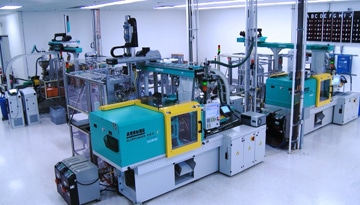 SSI has three automation cells making pipette tips, all built around Arburg injection-molding machines. Developed by Sepro America, the automation is design to increase molding efficiency and prevent possible DNA contamination.
On their website, Scientific Specialties Inc. (SSI), Lodi, CA, is described as making “injection molded plastic consumable and durable products for use in life science research laboratories.” More specifically, SSI is one of the leading suppliers in the world of tubes, pipette tips, racks and other products used in DNA extraction. This is a process that you see all the time in the crime labs on TV, except that it’s often automated and very high speed. That’s why SSI makes lots of pipette tips… millions and millions every week.
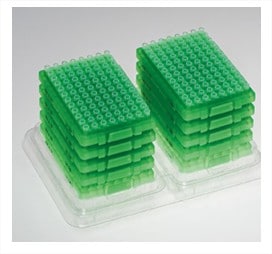 SSI manufactures pipette tips by the million for automated DNA extraction. Tips are packaged in trays of 72, which are stacked and packaged for ease of use. One key to success is using servo-driven robots and downstream automation supplied by Sepro America.
“We run pipette-tip molds with up to 32 cavities on cycles as short as 8 seconds,” explains Anthony McCracken, Director of Operations. “That means that each mold produces upwards of a quarter of a million tips each day, and the plant as a whole makes several million individual products each day.”One key to their success: automation, using servo-driven robots and downstream systems supplied by Sepro America.
“We use automation a little bit differently than most injection molders,” says McCracken. “Because our customers are testing for DNA, it is absolutely critical that there is no contamination on the products we manufacture. Where there are people, there is the potential for DNA contamination. Sure, robots don’t get tired and they don’t need to take breaks, so they do contribute to production efficiency, but the really critical thing for SSI is to put a barrier between the molding machines and the operators and our Sepro robots allow us to do that very effectively.”
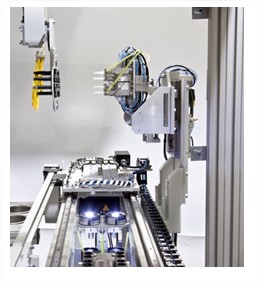 three post-mold automation systems that were installed to work in conjunction with robots SSI already had in place. In operation, the robot’s end-of-arm tooling (EOAT) picks the pipette tips out of the mold. Because the pipettes are gripped at the narrow end, opposite the base, and they need to go into their racks in the opposite orientation, the EOAT hands them off to a second fixture outside of the molding machine. This fixture then tilts 90° so it can place the tips point-down into a third fixture that shuttles them away from the molding machine and positions them above plastic drop tubes that guide them precisely into their racks in the correct orientation. Each rack holds 96 tips, so a servo drive indexes the racks to receive three sequential drops of 32 tips. Along the way, a camera is used to automatically inspect each pipette tip and any that fail are automatically removed from the process.
After picking them out of the injection mold, the end-of-arm tooling (upper left in photo) hands the tips off to a second fixture outside the molding area.
three post-mold automation systems that were installed to work in conjunction with robots SSI already had in place. In operation, the robot’s end-of-arm tooling (EOAT) picks the pipette tips out of the mold. Because the pipettes are gripped at the narrow end, opposite the base, and they need to go into their racks in the opposite orientation, the EOAT hands them off to a second fixture outside of the molding machine. This fixture then tilts 90° so it can place the tips point-down into a third fixture that shuttles them away from the molding machine and positions them above plastic drop tubes that guide them precisely into their racks in the correct orientation. Each rack holds 96 tips, so a servo drive indexes the racks to receive three sequential drops of 32 tips. Along the way, a camera is used to automatically inspect each pipette tip and any that fail are automatically removed from the process.
After picking them out of the injection mold, the end-of-arm tooling (upper left in photo) hands the tips off to a second fixture outside the molding area.
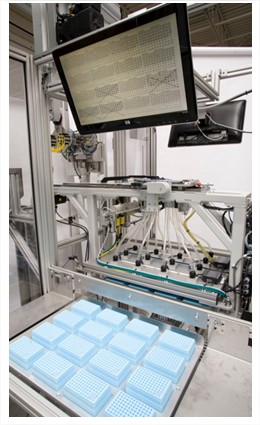 The second fixture then tilts 90° to place the tips point-down in shuttle that positions them above plastic drop tubes (see photo at right) that guides them precisely into their racks in the correct orientation. Machine vision ensures quality.
One of the three cells is slightly different from the other two in that it doesn’t have intermediate hand-off of pipette tips between the EOAT and the shuttle that moves the tips to the drop tubes. Because this cell produces smaller tips that the others, it was possible to design the drop tubes in such a way that the tips actually flip over along the way so that they land in the racks in the proper tip-down orientation.
All the automation cells were assembled at the Sepro America facility in Pittsburgh and thoroughly tested before shipment to SSI in California. McCracken says he has another cell on order, which will include some additional features to facilitate quick mold change. SSI produces pipette tips in several different sizes and, for added production flexibility, wants to reduce changeover times from “several hours to just a few hours or less.” This cell is set for delivery in October.
The second fixture then tilts 90° to place the tips point-down in shuttle that positions them above plastic drop tubes (see photo at right) that guides them precisely into their racks in the correct orientation. Machine vision ensures quality.
One of the three cells is slightly different from the other two in that it doesn’t have intermediate hand-off of pipette tips between the EOAT and the shuttle that moves the tips to the drop tubes. Because this cell produces smaller tips that the others, it was possible to design the drop tubes in such a way that the tips actually flip over along the way so that they land in the racks in the proper tip-down orientation.
All the automation cells were assembled at the Sepro America facility in Pittsburgh and thoroughly tested before shipment to SSI in California. McCracken says he has another cell on order, which will include some additional features to facilitate quick mold change. SSI produces pipette tips in several different sizes and, for added production flexibility, wants to reduce changeover times from “several hours to just a few hours or less.” This cell is set for delivery in October.
“Lots of companies supply beam robots,” says McCracken, “but Sepro can do the whole package and that is a huge advantage. The entire cell can be operated using the same control pendant. There just one control, one set of software and one methodology and so our people don’t need to learn several different systems. And when there are problems – and anyone who tells you automation doesn’t break down sometimes doesn’t really use automation – there’s only one company to call.”In all, SSI has 12 Sepro robots including 9 that are installed on machines without downstream automation or machines that have downstream automation developed in-house. The company runs a total of 46 Arburg machines and 3 Negri Bossi machines, ranging in size from 50 through 220 tons. “Sepro is currently the only automation supplier we use,” McCracken notes. “The Sepro robots are installed on various machines, including 3 two-shot or ‘multi-component’ machines, as Arburg prefers to call them.”
Receive a summary of our news and events every month

